The Curious Mind

Is This Art

Here is a question for you:

John Baldessari is a famous and respected artist.  The Broad Museum has a Baledessari picture.  Baldessari didn’t touch the piece (except maybe to sign it).  Here is how the Broad describes it:
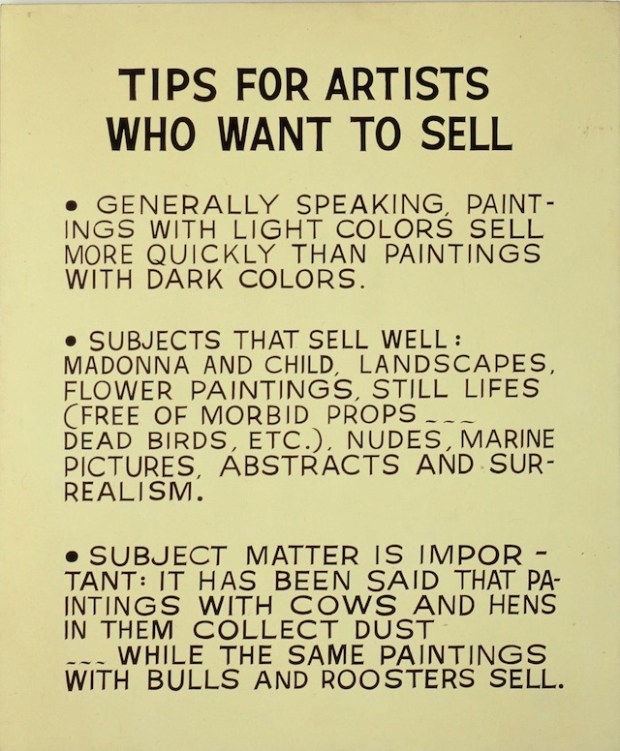
broad_inaugural_01

John Baldessari
Tips for Artists Who Want to Sell
1966-68
acrylic on canvas
68 1/4 x 56 1/2 x 1 1/2 in. (173.36 x 143.51 x 3.81 cm)
On View
Accession Date:
01/20/2000
Accession Number:
F-BALD-1P00.08
About this artwork
John Baldessari never touched this painting. He did not paint it. He did not write the text. “There is a certain kind of work one could do that didn’t require a studio,” Baldessari said, “It’s work that is done in one’s head. The artists could be the facilitator of the work; executing it was another matter.” This concept — that an artist could present an idea rather than a material object from their own hand — was a way for Baldessari to take apart the notion of what art could be. In 1966 art meant painting, sculpture, or drawing, and with wry humor, Baldessari challenges this expectation. The viewer receives a painting in Tips for Artists Who Want to Sell, but the painting is completed by sign painters. The viewer is presented with a painting’s content, but the content is text taken from an art trade magazine dictating what content should be .

In the second decade of the 20th century, Marcel Duchamp put a urinal signed “J. Mutt” on the wall of a  famous exhibition and said it was art because “I’m an artist and I say it is art.”  “Conceptualism,” one of the most lasting movements in art, was conceived.

What we have here is a piece of art where the art is untouched by an artist  nor was the idea behind it unique, nor did any other artistic hand touch the work (as might be argued with the work of Jeff Koons or Damian Hirst, whose artistic assistant’s execute the work).

Is this art?  Was Baldessari actually advancing the discussion of  Conceptualism beyond Duchamp?  Was he conceiving another question that makes this art?  Was he thumbing his nose at Conceptualism that makes this art?

A Good Word To Remember

I came across this in a book I was reading.  I think it is the first time I’ve seen this word:

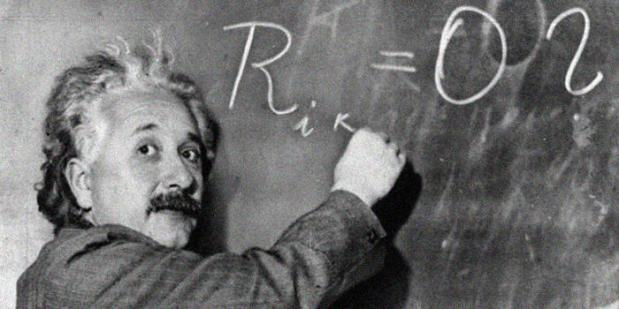
Eidetic memory (/aɪˈdɛtɪk/; sometimes called photographic memory) is an ability to vividly recall images from memory after only a few instances of exposure, with high precision for a brief time after exposure, without using a mnemonic device.

6752566165_2c4089d6c7_z

Zeugma

20131010_205225_

Here’s one for you.  I bet it is not a household word:

A zeugma is a literary term for using one word to modify two other words, in two different ways. An example of a zeugma is, “She broke his car and his heart.”

I want to thank my friend Carol Halstead for confounding me.  Cheers

Make an ass of you and me (assume)

donkey2

I was thinking about the root word “sume” as in assume, consume, presume, resume, subsume and even, perhaps, exhume.  Here is what it means:

sump, sume & sum
These ROOT-WORDS are SUME, SUMP & SUM meaning TAKE, USE & WASTE. They come from the Latin sumere & sumptus. It is interesting to notice how the idea of taking and using began to mean expensive, burdensome, and wasteful. The layman’s name for tuberculosis is conSUMPtion, a disease that causes the patient to WASTE away. In ancient Greece and Rome there was a SUMPtuary law which forbade lavish spending.

1. Assume : as SUME (a sume’) v. 

To take; to use; to suppose; as, I assume it is so

2. Assumption : as SUMP tion (a sump’ shun) n. 

The act of taking for granted; as, on the assumption that it is so

3. Assuming : as SUM ing (a sume’ ing) adj. 

Taking for granted; arrogant

4. Assumed : as SUM ed (a sumed’) adj. 

Taken; as, under an assumed name

5. Assumptive : as SUMP tive (a sump’ tiv) adj. 

Assuming; supposing

6. Consume : con SUME (kon sume’) v. 

To use up; as, Americans consume millions of cigarettes

7. Consumer : con SUME r (kon sue’ mer) n. 

One who consumes goods of some kind

8. Consumption : con SUMP tion (kon sump’ shun) n. 

Act of using up; wasting away

9. Consumptive : con SUMP tive (kon sump’ tiv) adj. 

Affected by consumption; a wasting away of the body

10. Consumable : con SUM able (kon sue’ ma b’l) adj. 

Can be used up

11. Consumedly : con SUME dly (kon sue’ med lee) adv. 

Excessively; as, he is consumedly proud of himself

12. Presume : pre SUME (pre zume’) v. 

To take upon oneself without leave; as, do not presume too much

13. Presumably : pre SUM ably (pre zue’ ma blee) adv. 

Supposedly

14. Presumption : pre SUMP tion (pre zump’ shun) n. 

Arrogance; audacity

15. Presumptuously : pre SUMP tuously (pre zump’ chu us lee) adv. 

Arrogantly; audaciously

16. Resume : re SUME (re zume’) v. 

Take up again; as, after intermission the play will resume

17. Sumpter : SUMP ter (sump’ ter) n. 

A beast of burden

18. Sumption : SUMP tion (sump’ shun) n. 

A major premise; an assumption

19. Sumptuosity : SUMP tuosity (sump tue os’ i ti) n. 

Lavish display

20. Sumptuously : SUMP tuously (sump’ chu us lee) adv 

Lavishly; expensively

Square Meal

school-food-1-640x458

Have you ever had a square meal?  Here’s why:

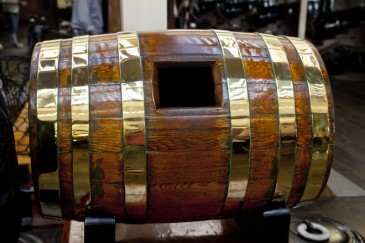
Most origin stories of the phrase claim it came from British and American naval ships of the 1700 or 1800’s. There are two versions of this story. The most common claims that sailors aboard ship had their meals served to them on square wooden trays or plates, that they either carried back to their bunks, where the plates could be stored easily, or that were stored elsewhere. Since they only used these squares when they were getting a full meal, probably dinner, the phrase ‘a square meal’ came to be associated with a full and satisfying dinner.

Which or That

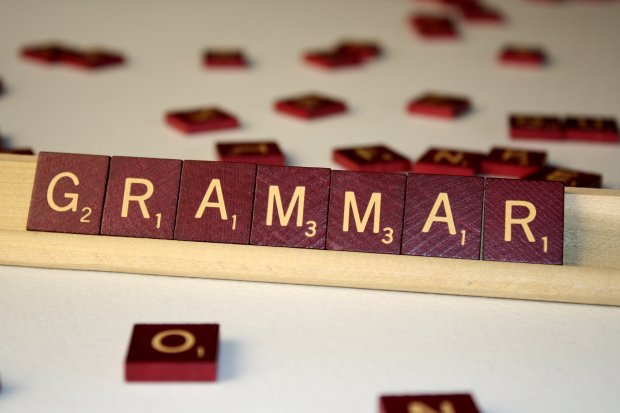
When to use “which” and when to use “that” hound me.  And maybe you too.  Here is the rule.  Good luck.grammar
The rule of thumb, then, is that which clauses are nonrestrictive (nonessential)while that clauses are restrictive (essential). Nonrestrictive clauses and phrases are set off from the rest of a sentence by a pair of commas (as in our examples above) or by a single comma if they come at the end of the sentence. (Example: “I took a vacation day on my birthday, which happened to fall on a Monday this year.”)
Merriam-Webster’s Collegiate Dictionary (10th edition), regarded by most writers as the authority on such matters, tells us that it is now common for which to be used with either kind of clause, while that must be used only for restrictive clauses. In fact, though, careful writers continue to make the distinction we describe above. Attorneys are taught to use which for nonrestrictive clauses and that for restrictive clauses so as not to cause a misreading in legal documents. It seems just as important that we work to avoid misreadings in all writing, not only in situations when a legal ruling might be at stake.

The Presidency

american-flag-post

Journalist H. L. Mencken observed in 1920:

“As democracy is perfected, the office represents, more and more closely, the inner soul of the people. We move toward a lofty ideal. On some great and glorious day the plain folks of the land will reach their hearts desire at last, and the White House will be adorned by a downright moron.”